
Spray foam is worth it where air leaks and moisture matter most: rim joists, sloped roofs, crawl spaces and metal skins. An open attic reaches R-49 to R-60 (most US zones) cheaper with loose fill, and a vapor barrier goes inside in cold zones but is usually left out in hot, humid ones.
Insulation questions usually come down to three things: whether spray foam is worth its price, how much to put in the attic, and whether the wall needs a vapor barrier. The answers depend on where the insulation goes and on your climate zone, so look up your zone on the US Department of Energy (DOE) map before you buy anything.
1. Is spray foam insulation worth it?
Spray foam insulation does two jobs at once: it insulates and it seals air leaks. That is why it pays off in places where air and moisture are the real problem, and why it is often money wasted where they are not. There are two kinds, and they behave very differently.
Open cell or closed cell
| What | Open-cell foam | Closed-cell foam |
|---|---|---|
| R-value per inch | about R-3.5 to R-3.8 | about R-6 to R-7 |
| Seals air leaks | Yes | Yes |
| Moisture | Lets vapor through; not below ground | Slows vapor at about 2 in; tolerates damp |
| Price | Lower | Higher, denser |
Where it pays off, and where it does not
Spray foam is worth it on rim joists, in cathedral ceilings and sloped roofs where there is little depth, on crawl space walls, and on steel skins such as metal buildings and shipping containers, where warm air meeting cold metal causes condensation. Closed-cell foam gives the most R-value in a thin wall. On an open attic floor it rarely pays: loose-fill insulation reaches the same R-value for much less.
DIY kits or a contractor
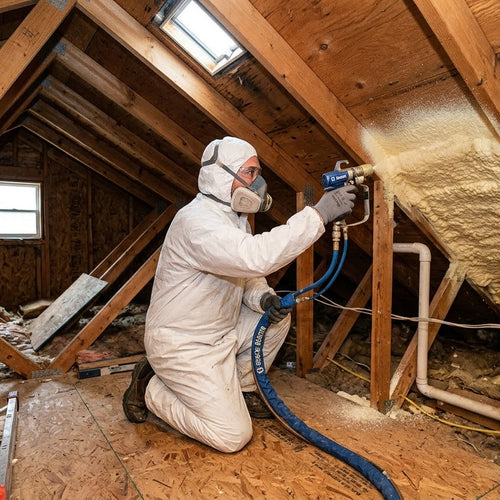
Two-part foam kits are made for small areas such as rim joists and gaps. Larger areas need special equipment and training, and DOE advises an experienced installer. The foam must be covered by a thermal barrier equal to 1/2 in gypsum board. Wear a respirator, eye protection and gloves, ventilate, keep other people out while it is sprayed and follow the maker's time before you move back in.
2. Attic insulation: how much you need
Attic insulation is usually the cheapest energy upgrade in a house. DOE recommends these levels:
| Climate zone | Attic with no insulation | Attic with 3 to 4 in already |
|---|---|---|
| Zone 1 | R-30 to R-49 | R-19 to R-38 |
| Zones 2 and 3 | R-49 to R-60 | R-38 to R-49 |
| Zones 4 to 8 | R-60 | R-49 |
Seal the air leaks first: top plates, wire and pipe holes, the attic hatch and gaps around the chimney. Then blow in cellulose or fiberglass, which fills around joists better than batts. Keep the soffit vents open with baffles, and keep insulation away from recessed lights that are not rated for contact. If you find old loose fill that looks like gray-brown pebbles, it may be vermiculite with asbestos: leave it alone and have it tested.
3. Do you need a vapor barrier?
A vapor barrier, or vapor retarder, slows moisture moving through a wall by diffusion. Codes sort them by how much vapor they let through:
- Class I: polyethylene sheet, foil facing.
- Class II: kraft paper facing on batts, closed-cell foam about 2 in thick.
- Class III: latex paint on drywall.
In cold climates the retarder goes on the side that is warm in winter, the inside. The model code (IRC) asks for Class I or II on the inside of framed walls in zones 5 to 8 and marine zone 4, with exceptions for walls that have enough exterior insulation. In hot, humid climates the moisture moves the other way, so a plastic sheet on the inside can trap it: leave it out there. Air leaks carry far more moisture than diffusion, so a well-sealed wall matters more than the sheet. Under a slab and on a crawl space floor, a polyethylene ground cover is a separate job and is needed in every climate.
4. Small buildings
Sheds, studios, tiny houses and ADUs have thin walls and little room for mistakes. Decide early which side of the wall stops air and vapor, run wiring before the walls are closed, and leave a way for any trapped moisture to dry out. A heated building needs the same care as a house; an unheated shed often needs only ventilation.
The LEVA ADU configurator shows each wall and roof layer, insulation and vapor control included, in 3D and in its bill of materials.
R-values per inch differ by product and between sources; the table gives the common range. The attic levels are DOE's recommendations; your local code may ask for other values. Check vapor control, spray foam fire barriers and any electrical work with your local building department or a qualified installer.