
A DIY chicken coop needs about 3 sq ft per hen inside, a covered run, wire that keeps predators out above and below ground, and air without drafts. Our default designs came to $519 to $1,959 in materials in the US.
A DIY chicken coop is less about looks than about what it keeps out and what it lets in. Whether you build a fixed coop with a run or a portable one, get these seven things right before you buy lumber. The numbers are for laying hens, the birds most backyard flocks keep.
1. Whether you may keep chickens
Call your local animal control or zoning office before you build or order birds. Many towns limit poultry or ban roosters, and your HOA may have its own rules. Ask how far a coop has to stay from the property line as well.
2. A coop with a run, or a portable coop
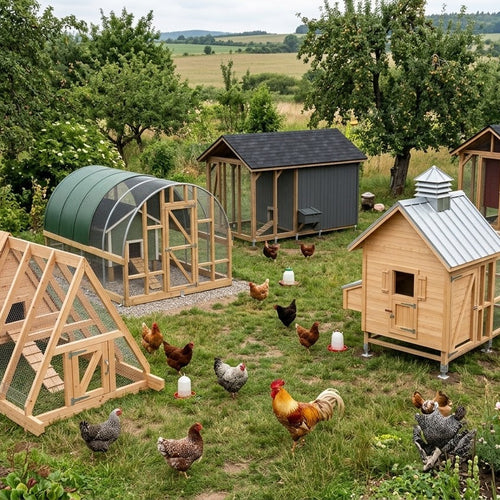
Decide this first, because it changes everything else. A fixed coop with a run suits a small flock in one spot: the hens sleep and lay in the coop and spend the day in a covered, fenced run. A portable chicken coop, often called a chicken tractor, has no floor under its run and is moved to fresh grass every day or every few days. It has to stay light enough to move, with wheels or handles, so it usually suits only a few birds. A walk-in coop is the third option: more room for you and the birds, and the easiest to clean.
3. Space per bird
Size the coop for the flock you will end up with, not the chicks you start with. Guides differ, but these are the usual numbers:
| What | Rule of thumb |
|---|---|
| Coop floor, with a run | 3 sq ft per bird |
| Coop floor, no run | 8 to 10 sq ft per bird |
| Run | 4 to 10 sq ft per bird |
| Nest boxes | 1 per 4 to 5 hens |
| Roost | 6 to 10 in per bird |
4. A predator proof coop
Keeping predators out comes down to the details. Cover windows and vents with 1/2 in hardware cloth. Bury the run's wire at least 6 in deep, or bend it outward along the ground for at least 12 in and staple it down, so nothing digs under. Fix the wire to the outside of the posts. Cover the whole run with wire or a solid roof. Raise the coop at least a foot off the ground and give it a solid floor.
5. Ventilation
Air has to move without blowing on the birds. Passive vents are enough for most backyard coops, with a fan for hot or humid spells. Give the coop openings you can adjust, and keep drafts away from the roost.
6. Nest boxes and roosts
A nest box about 12 in wide, deep and tall suits most hens. Keep boxes off the ground and not under the roosts. Roosts are usually 2x2 lumber with a rounded top edge, about 2 ft off the floor and 10 to 14 in apart. Many guides put them higher than the nest boxes, so hens do not sleep in the boxes. Keeping a few ducks too? They do not roost: they sleep on the floor and wet the bedding, so give them floor space of their own.
7. Cleaning
You will clean this coop for years, so think about how you reach the floor, the nests and the droppings. About 4 in of wood shavings keeps the floor dry. A large door or a walk-in design makes that work much easier, and a nest box you can open from outside saves a trip into the coop.
What it costs
In November 2026 we priced five default coop designs for the US. Labor is a little more than half of each total, so building it yourself is the biggest saving.
| Coop | Materials | With hired labor |
|---|---|---|
| Chicken tractor | $519 | $1,249 |
| Barn coop | $1,397 | $3,043 |
| Backyard coop | $1,399 | $2,996 |
| Cupola coop | $1,437 | $2,913 |
| Walk-in coop | $1,959 | $4,485 |
If you want to try your own size, you can configure a coop in LEVA.
The measurements here are common rules of thumb from university extension guides, and they differ on the details. The budgets are LEVA's default designs priced with US prices on November 4, 2026. They are budgets, not quotes.