
For a small, well-insulated building a ductless mini split is the easiest all-round choice: it heats and cools, needs no chimney and runs on one electric circuit. A wood stove wins off-grid or where power fails, but needs clearances, a proper chimney and a yearly inspection.
Most small buildings end up with one of three answers to the heating question: a ductless mini split, a wood stove, or a dedicated heater for a garage or workshop. Which one fits depends less on the equipment than on the building: how well it is insulated, whether it has reliable power, and how you use it.
1. Mini split: heat and cooling on one circuit
A mini split is a heat pump in two parts: an outdoor unit and one or more wall heads inside, joined by a small bundle of refrigerant lines, a drain and a cable through a hole about 3 in wide. With no ducts, nothing is lost in an attic or crawl space, which is why the US Department of Energy points to ductless heat pumps for additions and small spaces.
- Cold weather: standard models lose capacity in hard frost; cold-climate models are rated to keep heating well below 0 F. Check the capacity at your design low, not only the headline rating.
- Size: a rough start is 20 to 30 BTU per square foot, less in a tight, well-insulated building, more in a drafty one or a cold zone. A 9,000 to 12,000 BTU head covers many cabins and ADU rooms. An oversized unit short-cycles and dries the air badly.
- Power: most units need a dedicated 240 V circuit and an outdoor disconnect.
- Refrigerant: opening and charging refrigerant lines requires EPA Section 608 certification. DIY kits come pre-charged with sealed quick-connect lines; with standard units, a certified technician makes the connection and pulls the vacuum.
2. Wood stove: heat without the grid
A wood stove makes sense where power is unreliable, the building is off-grid, or firewood is cheap and close.
- Buy a certified stove. Current EPA-certified stoves burn far cleaner and use less wood than older ones, and some areas only allow certified models.
- Clearances: a listed stove goes exactly as its label and manual say, often 12 to 18 in from combustible walls with the right shielding. An unlisted stove needs 36 in under NFPA 211. Combustible floors need a non-combustible hearth pad that extends beyond the door.
- Chimney: use a listed class A chimney or the venting the stove maker specifies. The common rule is at least 3 ft above the point where it leaves the roof and 2 ft higher than anything within 10 ft.
- Safety: smoke and carbon monoxide alarms, a yearly inspection and sweep (fire officials recommend once a year), and only dry wood, which cuts creosote.
Small buildings overheat easily: a stove sized for a house turns a 200 sq ft cabin into a sauna. Pick a small firebox, and remember that a stove gives no heat while nobody is there to feed it.
3. Garage heater: match it to how you use the space
A garage or workshop is usually heated in bursts, not all day.
- Electric unit heater (240 V): simple, clean and quiet. A rule of thumb is about 10 W per square foot in an insulated garage, so a 5,000 W unit for about 500 sq ft.
- Vented gas or propane unit heater: fast, strong heat for larger or colder garages; it hangs from the ceiling and vents outside. Gas lines and venting are work for a licensed installer.
- Mini split: the best choice if you work out there most days or want cooling too.
Never run an unvented propane or kerosene heater in a closed garage: it burns room air and releases carbon monoxide. Keep any open flame or hot element away from fuel, solvents and sawdust.
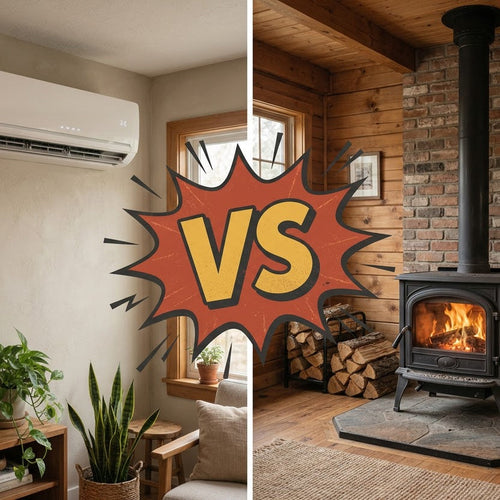
4. Mini split vs wood stove side by side
| Question | Mini split | Wood stove |
|---|---|---|
| Works in a power cut | No | Yes |
| Cools in summer | Yes | No |
| Keeps heat while you are away | Yes, on a thermostat | No |
| Main install work | 240 V circuit, wall hole, line set | Chimney, roof flashing, hearth, clearances |
| Yearly care | Clean filters and the outdoor coil | Inspection, sweep, firewood |
| Best for | ADUs, cabins and rooms used often | Off-grid cabins, cheap wood, backup heat |
Many owners combine them: a mini split for everyday heat and cooling, a small stove as backup and for the evenings.
5. Before you buy anything
Insulate and air-seal first. Every inch of insulation and every sealed gap makes the heater smaller and cheaper to run, and an uninsulated shell will not stay warm whichever option you pick. Then check with your local building department: a wood stove, a gas heater and a new 240 V circuit usually need a permit, and the inspection is part of what keeps them safe.
Sizes, clearances and wattages above are common rules of thumb from equipment makers, the EPA and the US Department of Energy; makers and local codes differ. The stove or heater manual and your local code always come first, and electrical, gas and chimney work should be done or checked by a qualified professional.
If you are planning a cabin or a small house, the A FRAME configurator on LEVA shows its heating and ventilation in 3D and lists every part in the bill of materials, next to the walls and insulation the heat has to work with.