
An outdoor sauna works when five things are right: a type that suits your winters, a heater sized to the room, insulated walls with a foil vapor barrier, low-in high-out air and a level, dry base. Our 52 reference designs came to $10,993 to $58,770 in the US.
An outdoor sauna is a small building that has to hold close to 190°F for an hour, then dry out again, through every season. Whether you buy a kit or plan a DIY sauna from scratch, these five things decide how well it works and how long it lasts.
1. Barrel sauna or cabin sauna
A barrel sauna is a round shell of thick staves held by steel bands. It goes up fast and its round shape leaves little air to heat, so it warms up quickly. The staves are usually the only wall, though, with no insulation or vapor barrier, so a barrel loses more heat in a cold winter and is hard to insulate later. The staves also move with the seasons, and the bands need tightening.
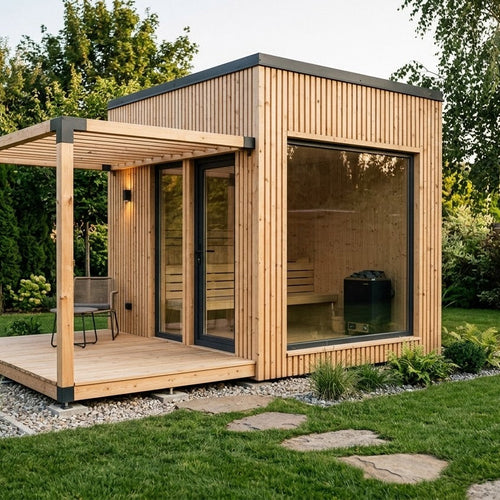
A cabin sauna is a framed box with insulated walls. It takes longer to build, but it holds heat better, gives you full headroom and is easy to fit with a changing room or a porch. If you use the sauna through a northern winter, a cabin is usually the better choice.
Size it for the people who will use it at once: a 6 x 8 ft room seats two or three. Keep the ceiling at about 7 ft and never above 8 ft, since heat collects at the top and a tall room never warms where you sit.
2. The heater: electric or wood
A common rule for electric heaters is about 1 kW per 45 to 50 cubic feet of room, plus 20 to 30 % for an outdoor or barrel sauna or a lot of glass. Most traditional heaters run on a dedicated 240 V circuit with its own breaker, and an outdoor building also needs a feed from the house. That work belongs to a licensed electrician, with a permit.
A wood-burning stove needs no power and suits a sauna off the grid, but it needs a chimney and the clearances its maker lists to walls, ceiling and benches. Follow the stove's manual and your local code, and put a carbon monoxide alarm where people sit and change.
3. Walls that keep the heat in
In a cabin sauna the walls and ceiling are framed and insulated, often with 3 1/2 in of fiberglass (about R-12). Over the insulation, on the room side of the studs, goes a foil vapor barrier with taped seams, then the wood lining. Do not use plastic sheeting there: it is not made for sauna heat.
For the lining and benches, use plain softwood that stays cool to the touch: cedar, hemlock, spruce or aspen. Never use treated, painted or varnished wood inside the hot room. Put the upper bench high, where the heat is, but leave enough room to sit up straight.
4. Air in, air out
A sauna needs fresh air without a draft. The usual layout is an intake low on the wall behind or under the heater, about 6 in above the floor, and an outlet high on the opposite wall or near the ceiling, never on the same wall as the intake. Size the two openings about the same. Keep the vents open while the sauna is in use and leave the door open afterwards so the wood dries.
5. A level base and a permit
Water runs off a sauna floor and snow piles against its walls, so the building has to sit level and dry. Concrete piers, ground screws, a compacted gravel pad or a slab all work for a small sauna; keep the wood off the ground and let water drain away from it. Small detached buildings often need no building permit, but the electrical work or a wood stove usually does, and setbacks still apply. Ask your local building department before you start.
What a DIY sauna costs
In November 2026 we priced 52 reference sauna designs with US prices. They came to $10,993 to $58,770, with $22,189 in the middle. Labor is about a third of each total, so building it yourself is the biggest saving.
| Sauna | Materials | With hired labor |
|---|---|---|
| 6 x 8 ft | $7,481 | $10,993 |
| 8 x 8 ft | $8,605 | $12,431 |
| 8 x 12 ft | $12,362 | $18,004 |
| 10 x 14 ft | $15,344 | $22,136 |
| 12 x 20 ft | $21,814 | $32,177 |
If you want to try your own size and layout, you can configure a sauna in LEVA: it shows the walls, the heater and the roof in 3D with a bill of materials.
The sizing, insulation and ventilation figures are common rules of thumb from sauna heater makers and builders, and they differ on the details. Electrical work, wood stoves and permits depend on your local code, so ask a licensed electrician and your building department. The budgets are our reference designs priced with US prices in November 2026. They are budgets, not quotes.